
mutltiscape
the new design strategy for
autodromo nazionale monza

In collaboration with Autodromo Nazionale Monza & Politecnico di Milano
my role: design strategy, branded environment, branding
This work is the result of over a year of activity as part of the experimental Thesis Incubator Studio at Politecnico di Milano and cooperation with Autodromo Nazionale Monza.
TIS is an innovative project that allows collaboration between School of Design of Politecnico di Milano program and the leading professors and researchers with external companies. The projects cover a variety of areas and project scales, from general landscapes to interior design and related activities.
The main idea is to operate within the Design-Driven Innovation strategy. The starting point for the project is detailed research that leads to the creation of innovative solutions.


Visual research data arrangement
branded environment is a physical manifestation and a link between brand and the user
Today, the branded environment is one of the most important elements of the overall brand strategy. It combines many areas, including architecture, landscape, and furniture design, which are the physical manifestation and a link between the brand and the user. It allows to experience the brand on a deeper level and create a solid foundation to strengthen the relationship with users. The goal of this project is to analyze this correlation on the example of the Autodromo Nazionale Monza and, as a result, the creation of the design strategy, which, through the variety of tools from digital, graphic, up to the space design, will build a coherent brand image.
Multiscape experience is the sum of five aspects that must exist to create a complete experience. Based on the research, a joint multi-layer program of interdependent elements has been developed. The diagram refers to the aforementioned circuit of landscape and circuit of the culture built by Du Gay, but its framework has been tailored to the needs of branding environments.
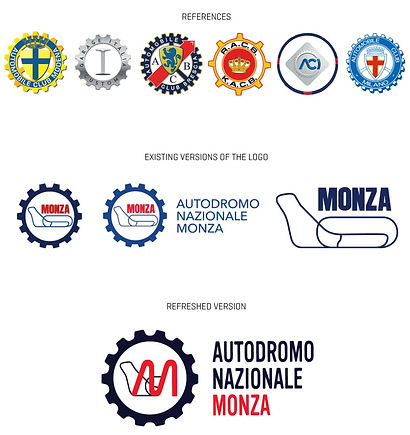
Building the Multiscape Experience starts with the identity of Autodromo Nazionale Monza.


In order to implement a branding strategy, the branding structure is introduced to clearly see the necessary elements, their functions, the scope of operation, type, and the level of availability. This helps to choose the appropriate element required in a given scape, or even create new ones, according to current needs, but always being a continuation of the existing ones. The structure is a cross-section of the layers, so as to easily control several areas, from architectural elements to marketing activities simultaneously.
This allows to manage the elements and build a coherent strategy based on integrated activities at various scales. It can be treated as a guideline that sets a certain path but does not limit the creation of new solutions.



Wayfinding system


Just as Autodromo Nazionale Monza is multi-layered, the project also consists of several layers that overlap, support, and complement each other, creating a multiscape experience. The first two lower layers relate to wayfinding, creating a system that facilitates communication around the park and the track. The first layer contains 2D elements, i.e. all kinds of graphics and signs on the ground or on the facade of buildings, walls, or other surfaces, and these are usually directional or identification signs. The second layer is physical marking in the form of boards, totems, or other architectural elements, also referring to the system of finding the right way. The third category includes other 3D elements such as street furniture or urban furniture. According to the assumed strategy, these three layers make up the hardware.


